Using AI to Plan a Disney Trip? 9 Things to Check Before You Trust It
Not long ago, planning a Walt Disney World trip properly meant forty hours of blogs, spreadsheets, and message board archaeology. AI has genuinely changed that. Ask a question, get an answer in seconds. For a lot of families, it's the first tool that makes Disney planning feel less like a second job.
Here's the catch: an AI answer always sounds right. The confident tone is the same whether the tool is working from live park data or from a two-year-old memory of a FastPass system Disney retired. And a wave of hastily-built "AI Disney planners" has flooded in to take advantage of exactly that.
So before you hand your vacation to any AI — ours included — put it through these nine checks. This is the standard we built ParkSwiz against, and we think it's the standard everyone should be held to.
Is the information current, or frozen in the past?
This is the classic failure mode of asking ChatGPT to plan your trip, and it's worth understanding why it happens.
Language models learn from training data with a cutoff date. Everything the model "knows" about Disney World was true as of that date — and Disney never stops changing. Genie+ became Lightning Lane Multi Pass. Rides close for refurbishment. Restaurants open, close, swap menus. Park hours and party dates shift every month.
Ask a general chatbot for an itinerary and you might get a gorgeous, well-organized plan built around a closed ride and a purchasing system that no longer exists. It looks authoritative. You find out it isn't while standing in the park.
We don't have to imagine this one. In late August 2026 we asked a live AI planning site for an itinerary for an October 2026 trip. It told us to buy Genie+ at park open — a system Disney retired in July 2024 — and moved Tiana's Bayou Adventure to the wrong land while it was at it.
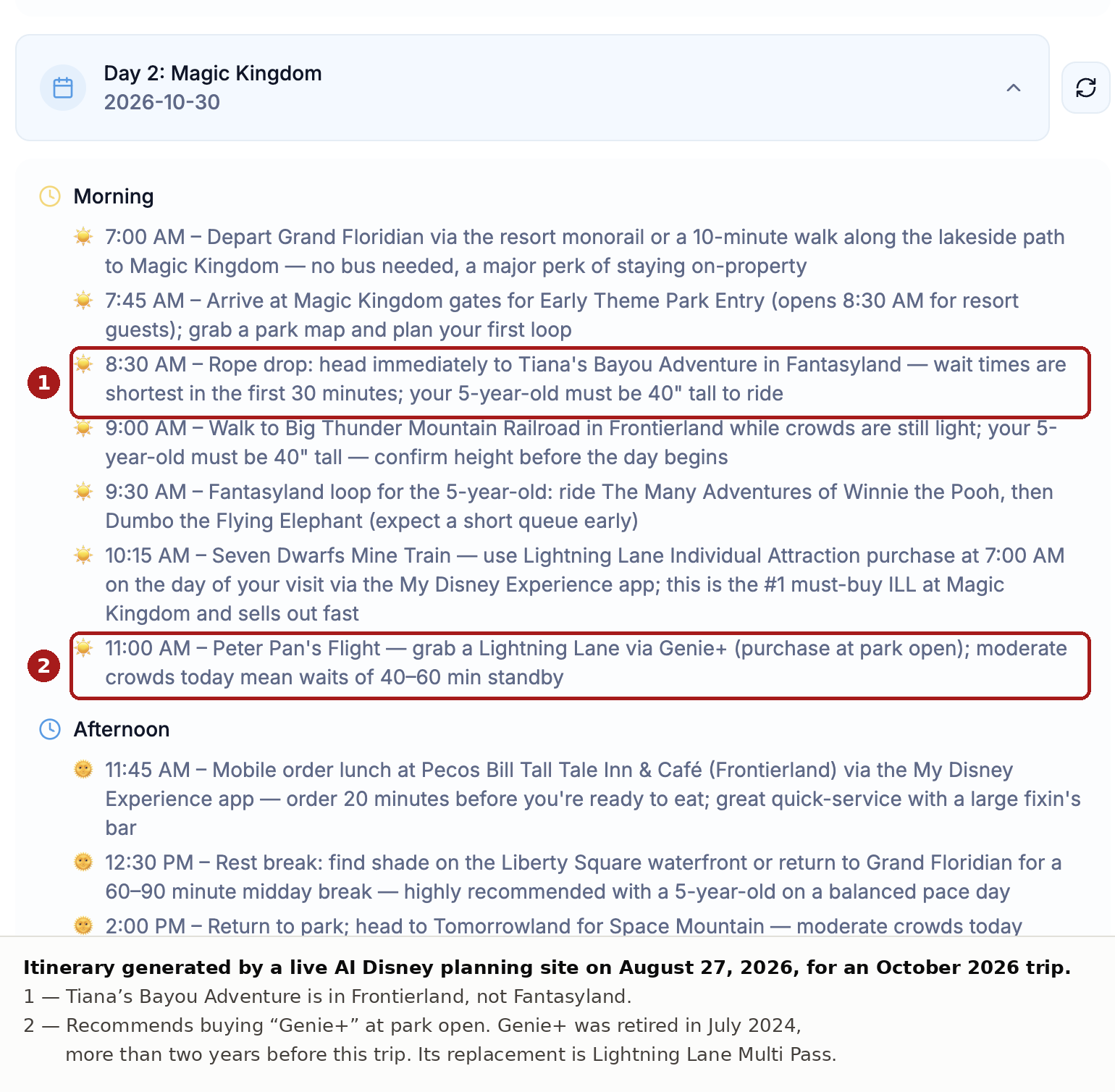
The fix is grounding: an AI that pulls from a maintained, updated knowledge base instead of leaning on whatever it memorized in training. That's how Ask Swiz works — it draws on a continuously updated library, including 35,000+ real facts and experiences organized by AI, so the answer reflects how the parks work now.
Are the wait time "projections" real, or just someone else's data with a haircut?
Wait times are the backbone of any touring plan, so start here. It's also where the AI gold rush gets ugliest.
There's excellent public wait time data out there — Queue-Times and Thrill Data both do great work — and plenty of AI sites pipe it in. Nothing wrong with that. The problem is what happens next. We've seen a site take the current posted wait, subtract 15%, and call it a projection model. Others just serve long-run averages, which tell you what Space Mountain's line has looked like over the past few months. Not what it will look like at 2pm on the Tuesday you're actually standing there.
That's not a model. That's arithmetic in a lab coat.
We took the harder road: ParkSwiz runs its own data feeds and built its own projection models from scratch. Right now, 51% of our projected wait times land within 5 minutes of the actual wait, and 77% land within 10. The typical model? Within 5 minutes less than a third of the time, and within 10 minutes maybe 70% of the time on a good day. That gap is the difference between walking onto a ride and losing half your morning to a line you were told would be short.
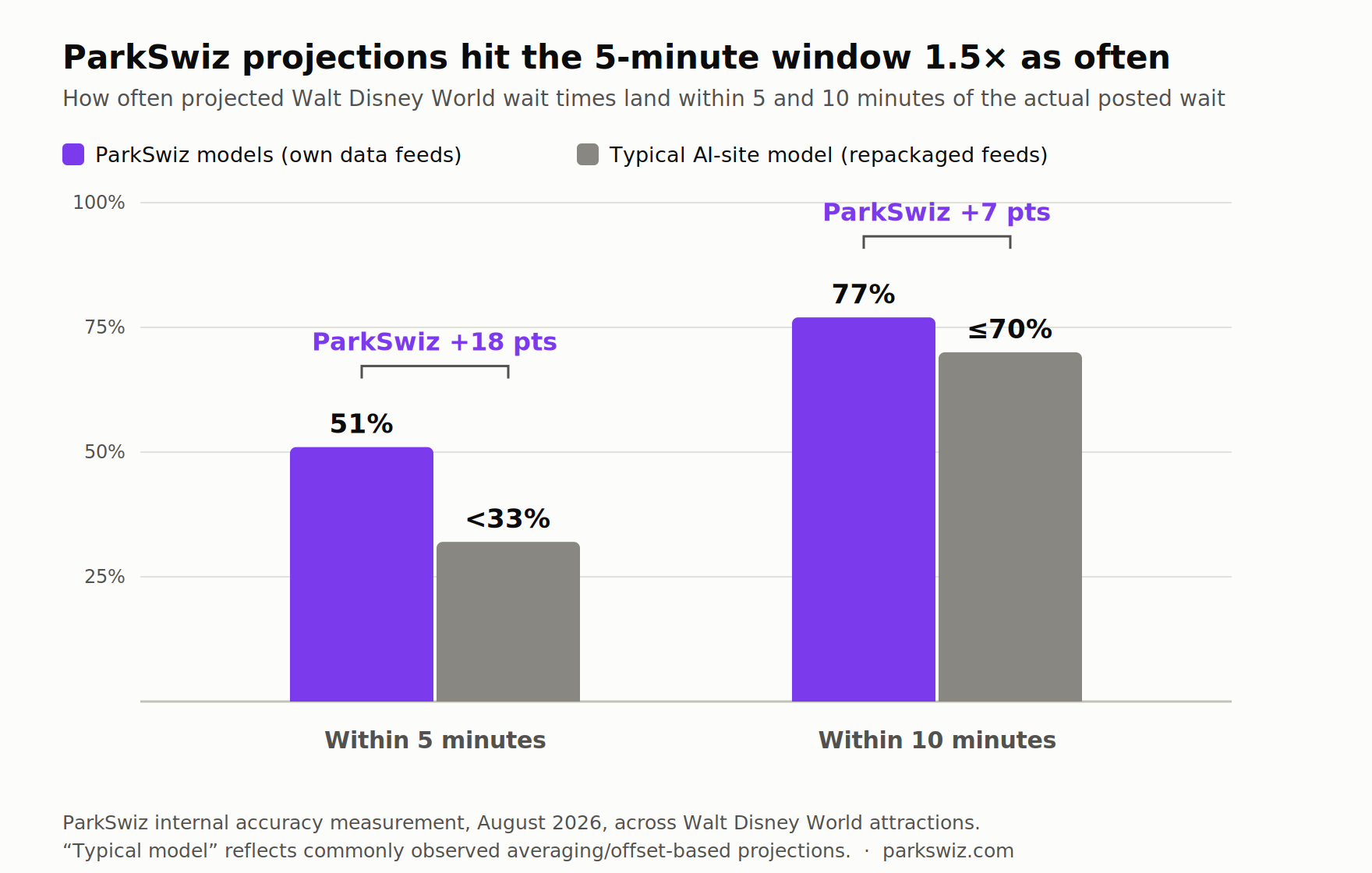
Simple test: if a site claims to project wait times but won't tell you how accurate the projections are, there's probably a reason.
See what our projections say about your dates — free, no credit card.
Was the site built for readers, or by a content farm?
You know these sites when you land on one. A wall of ads. Paragraphs that circle the question without ever answering it. A stock photo of the wrong castle. Two thousand words of throat-clearing before the one fact you came for.
The SEO world calls it slop, and Disney content is drowning in it, because Disney traffic is lucrative and generating plausible filler is now basically free. The tells are consistent: prose generic enough to describe any theme park, small factual errors (ride names slightly off, dead systems mentioned as current), every article suspiciously the same length, and no sign that anyone who has actually stood in line for Seven Dwarfs Mine Train ever read the page.
There's a subtler tell, too: the echo. AI-built sites don't write — they orbit whatever's already ranking, and the phrasing converges. Spend enough time in this space and you'll see your own headlines come back at you with one word swapped. We have.
Depth is hard to fake. Does a guide distinguish rope drop with toddlers from rope drop with teenagers? Do the accessibility notes cover transfer requirements and sensory issues, or just say "wheelchair accessible" and move on? ParkSwiz publishes 300+ guides — monthly crowd and weather breakdowns, head-to-head ride matchups, budget tiers, rides grouped by height requirement, a dozen accessibility deep-dives — because that's the level of detail a content generator can't bluff.
One more thing about slop, and it matters more than the wasted reading time: it's a leading indicator. A site that cuts corners on the content you can see is cutting corners on the security you can't. If you see slop, expect security issues.
Does it hand you an answer, or a homework assignment?
Slop has an opposite, and it's almost as exhausting: the data dump. Some planning sites bury you in the stuff — a crowd calendar for every month, a historical chart for every attraction, dashboards nested inside dashboards. Impressive, sincerely. But you came to plan a vacation, and now it's 11pm and you're scrolling through your fortieth chart trying to synthesize it all yourself. That's not planning. That's an unpaid analyst job with worse hours.
Here's the thing: more data is only a gift if someone else does the reading. We're data obsessives at ParkSwiz — that's how the projection models got built — but the obsession is ours so it doesn't have to be yours. The job of a good tool is to absorb the hundred charts and hand you the decision: go Tuesday, rope-drop this, book that at 7am, skip Multi Pass. The data stays underneath for anyone who wants to dig, but nobody has to.
Here's what that difference looks like in practice. We asked another AI planner — one built on a daily crowd index — which Lightning Lane to book. To its credit, it admitted it couldn't compare the rides from its data, and handed the decision back to us. The same question, put to Swiz the same day, came back with per-ride waits, sell-out patterns, and a heads-up that one of the three rides was down.
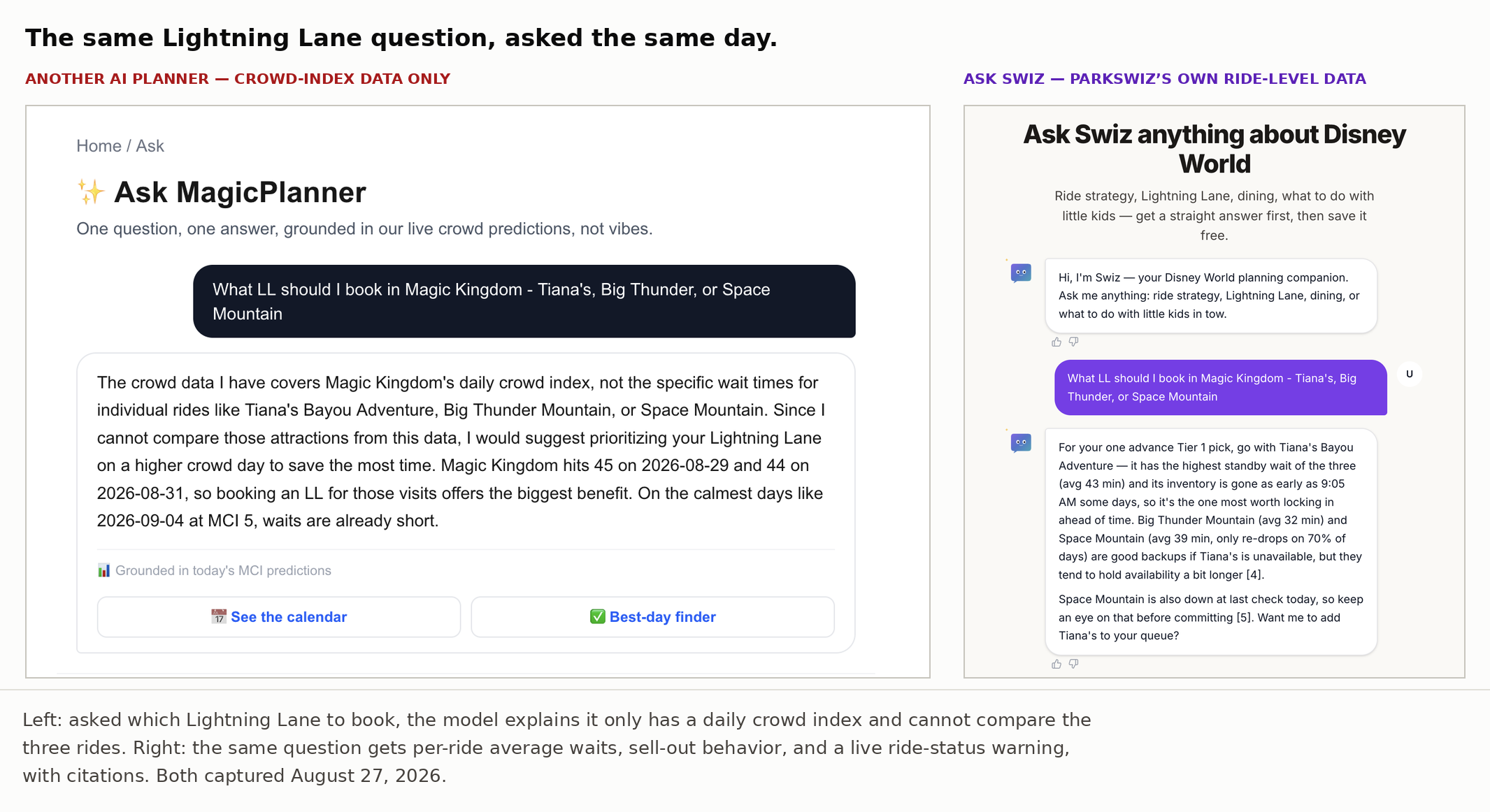
The test is simple. After twenty minutes with a planning site, do you have a plan — or just more tabs open than you started with? A tool that adds to the overwhelm has failed at the one thing it exists to remove.
Does it know your trip, or does everyone get the same answer?
"Best rides at Magic Kingdom" means three different things for a family with a 3-year-old, a couple chasing coasters, and a grandparent using a wheelchair. A tool that doesn't know who's going can't tell you whether a 60-minute wait is worth it, because the honest answer is: worth it to whom?
Some tools don't even listen. The same site's planning chat gave us the identical scripted reply — word for word — to two completely different questions, one about Lightning Lane strategy and one about where to find tampons in the park. That's not a conversation. That's a form wearing a chat skin.
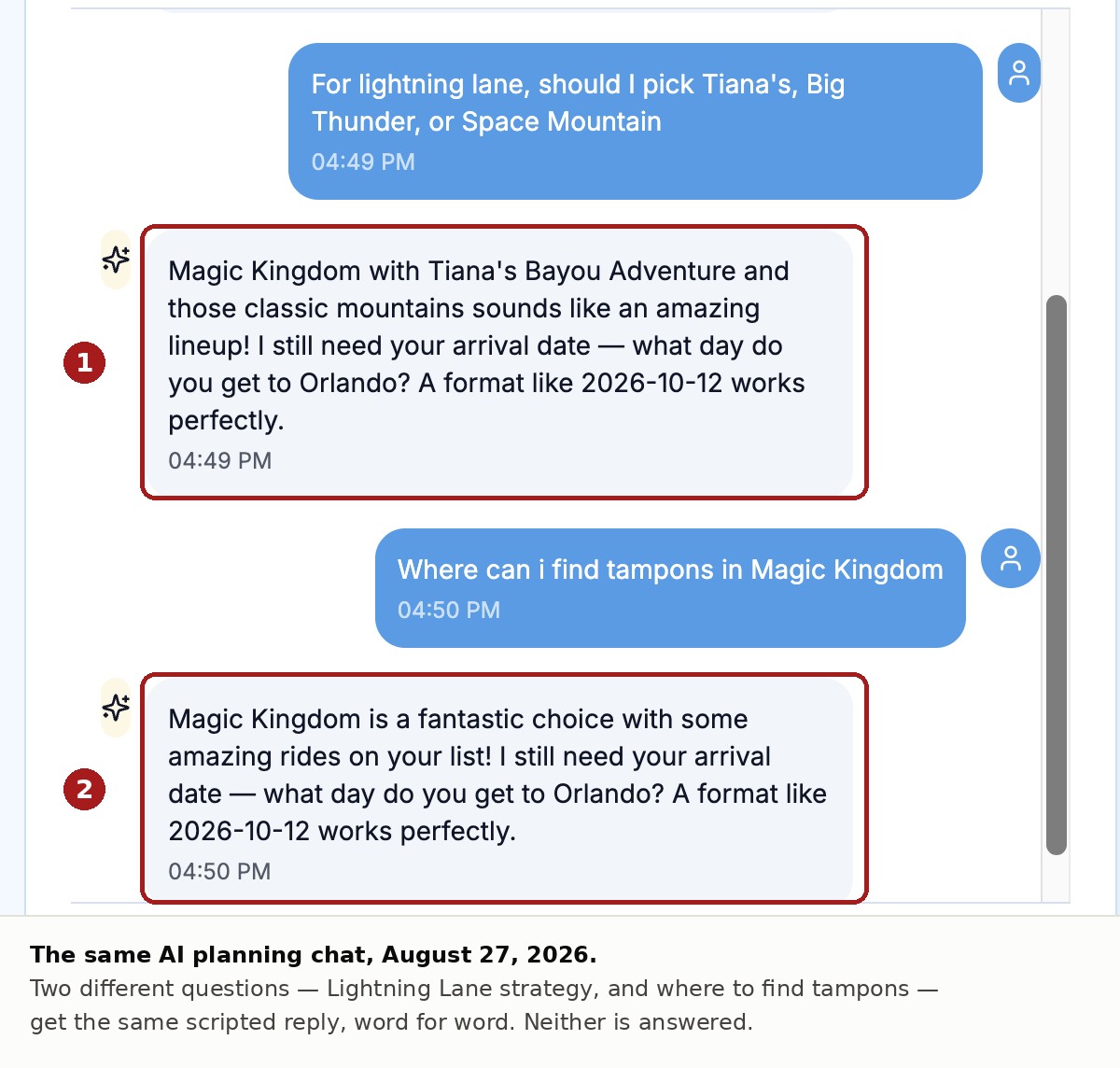
This is why ParkSwiz starts with a Trip Profile instead of a chat box — your parks, dates, group, accessibility needs, and priorities — and filters everything through it. Attractions, dining, guides, every Ask Swiz answer. It's also how you get straight answers to the expensive questions, like whether Lightning Lane Multi Pass is worth it for your dates and your group. Sometimes the right answer is "skip it, keep the money." A tool that knows your trip can say so.
Build your free Trip Profile — it takes about a minute.
What happens to your data?
Think about what you actually tell a Disney planning tool: exactly when your family will be away from home. How many kids you have and how old they are. Your budget. Sometimes accessibility or health-adjacent details. That's sensitive information, and plenty of free tools pay their bills by monetizing it.
Three questions any tool should answer in writing. Does the company sell or share your personal information? Are your conversations used to train AI models? Are sensitive details like accessibility preferences kept away from advertisers?
Our answers are in our privacy policy, on the record: we never sell, rent, or trade personal information. The AI providers powering ParkSwiz don't train their models on your data. And accessibility preferences are never shared with advertisers or marketing platforms, full stop. If a tool can't give you those three answers in writing, assume the answers are ones you wouldn't like.
Is the data actually secured?
A privacy promise means nothing without security behind it. Travel dates plus a home address is a burglar's shopping list. A child's name plus an itinerary is worse.
The basics for anything handling family travel information: encryption in transit and at rest, database-level controls so users can only ever touch their own data, rate limiting, regular security reviews. ParkSwiz does all of this. It's not exotic — it's table stakes. But a site assembled in a weekend from AI-generated pages was not assembled with any of it in mind, which brings us back to the rule from the slop section.
Can it handle accessibility, or is it an afterthought?
This is where generic AI fails hardest, and the stakes are highest. DAS registration, Rider Switch, wheelchair transfer requirements, sensory considerations, Location Return Times — these details decide whether a trip works at all for many families, and general chatbots routinely get them wrong or skip them entirely. ParkSwiz builds them into attraction information by default — wheelchair routes, transfer requirements, sensory notes — backed by twelve dedicated accessibility guides.
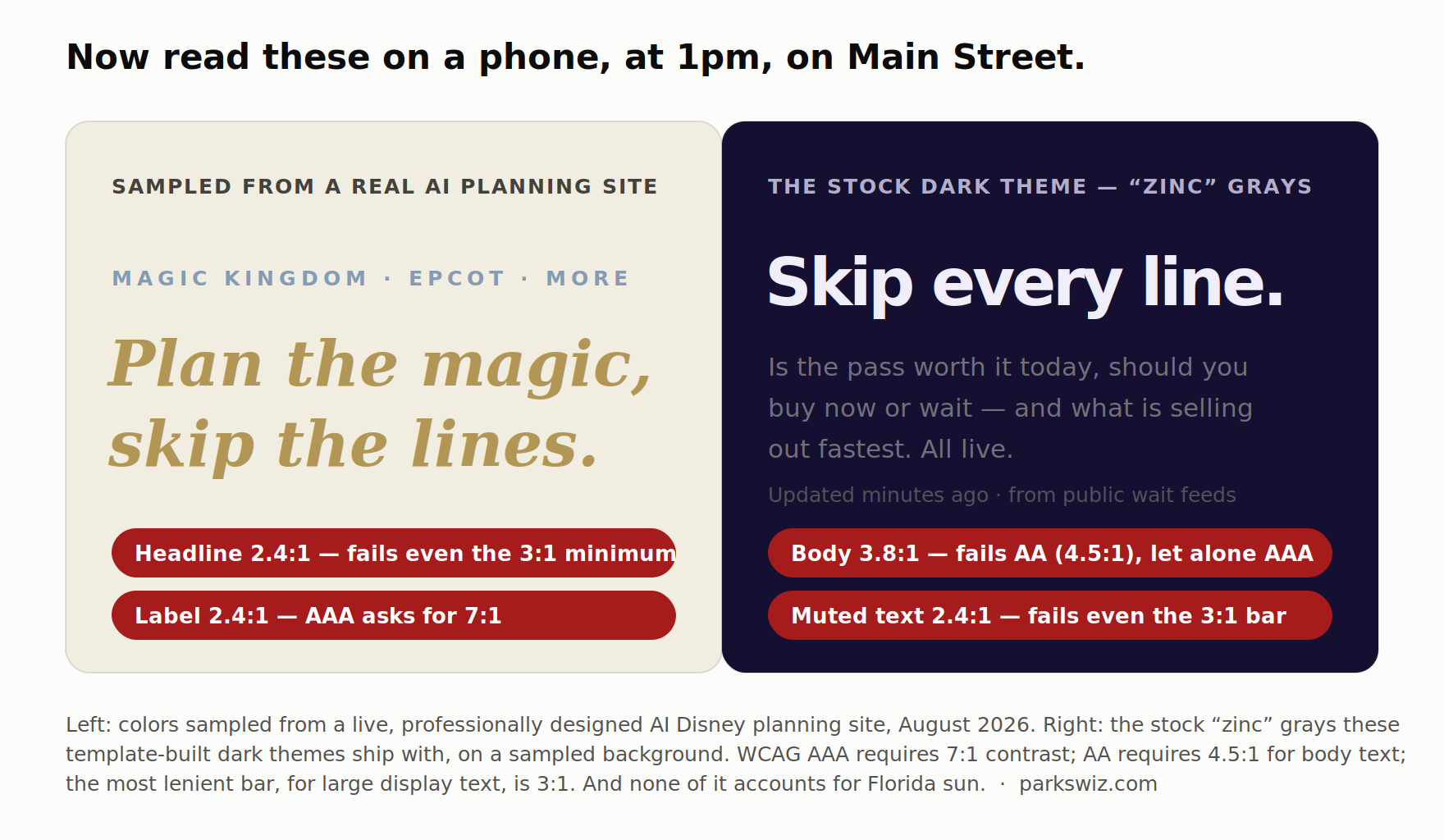
But accessibility is also about the design of the tool itself, and here comes the slop again: pale gray text, thin trendy fonts, tap targets sized for a stylus, layouts generated by a model that was never asked to read its own output. And to be clear, slop can be pretty. We recently measured the homepage of one polished, professional-looking AI Disney planner: its elegant gold headline came in at a contrast ratio of 2.4:1. Accessibility guidelines ask for 7:1 at the strictest level; even the most lenient bar for large text is 3:1. That headline is decoration you're meant to admire, not text you're meant to read.
The other failure is so common it has a color name: zinc. Template-built dark themes ship with stock muted grays for secondary text, and on a dark background the standard steps measure 3.8:1 for body copy — short of AA's 4.5:1, nowhere near AAA's 7:1 — and 2.4:1 for captions, below even the large-text bar. It looks sleek in a screenshot. It disappears on a phone in daylight. And none of these numbers account for Florida sun, which is why our standard is "readable in the park," not "passes the checker."
ParkSwiz is built to be generally WCAG AAA compliant — the strictest tier of the Web Content Accessibility Guidelines. In plain terms: text contrast of at least 7:1 (most sites settle for 4.5:1), readable sizes, and an interface that works for low-vision users, older eyes, and everyone else.
Why fuss over contrast ratios for a vacation planner? Because you won't be using it on a nice monitor in a dim office. You'll be on a phone, one-handed, in full Florida sun, glare on the screen, churro in the other hand. If you're squinting at a site on your laptop at home, imagine 1pm on Main Street in July. Design that fails in your living room fails completely in the park.
Is it honest about what it is?
No legitimate planning tool is affiliated with The Walt Disney Company, and the trustworthy ones say so plainly. Be wary of anything that implies official status, hides who runs it, or buries its disclaimers. In our experience, honesty about what a tool is tracks closely with honesty about what it knows.
The bottom line
AI is the best thing to happen to Disney planning in a decade — when it runs on current data, knows your group, and respects your privacy. Used carelessly, it's a confident liar holding last year's park map.
Run any tool through the nine checks above. If you want to see one built to pass them, create a free Trip Profile on ParkSwiz — takes about a minute, no credit card — and ask Swiz the hardest question you've got. Keep the magic. Lose the overwhelm.
Frequently asked questions
Can ChatGPT plan a Disney World trip?
It can draft one, but its knowledge has a training cutoff, so it regularly recommends retired systems (Genie+, FastPass+), closed attractions, and stale pricing. Verify anything it says against a source that's actively updated.
How accurate are AI Disney wait time predictions?
It depends entirely on the model. Typical projections land within 5 minutes of the actual wait less than a third of the time. ParkSwiz's models, built on our own data feeds, are within 5 minutes 51% of the time and within 10 minutes 77% of the time.
How is ParkSwiz different from asking a general AI chatbot?
ParkSwiz grounds its answers in a continuously updated Disney World knowledge base with 35,000+ real facts and experiences, runs its own wait time feeds and projection models, personalizes everything through your Trip Profile, and commits in writing to never selling your data or training AI on it.